
New Bispecific Patent dataset helps drug developers interpret bispecific IP activity, track emerging rivals and make more informed strategic decisions.

Beacon Intelligence has launched Beacon Bispecific Patents, a new dataset designed to give drug development teams a clearer view of competitor IP and strategic direction in the fast-growing bispecific antibody field.
Built as part of the wider Beacon Patents platform, the bispecific dataset helps scientists, patent specialists and competitive intelligence teams move beyond keyword searches and dense legal language to understand who is filing what, where and why. The focus is on turning complex patent activity into practical insight that can guide R&D and business decisions with greater confidence.
From scattered filings to a joined-up competitor picture
Bispecific and multispecific antibodies are attracting intense investment, but the associated patent activity is fragmented across formats, mechanisms and jurisdictions. Traditional and AI-only patent tools often surface a high volume of loosely relevant documents, leaving users to manually piece together which competitors are active in their space and how those programmes are evolving.
Beacon Bispecific Patents has been created to close that gap. Using Beacon’s scientific ontologies, expert curation and trained AI models, the platform filters more than 100,000 bispecific-related patents to highlight filings that genuinely matter for innovators working with these modalities. Users can search by mechanism of action, molecular format, targets, disease indication and other bispecific-specific attributes to quickly pinpoint patents that overlap with their own strategies or signal new areas of interest.
Andy Cook, Chief Data Innovation Officer, at Beacon said: “Patent filings are often the earliest public sign of a competitor’s plans, but they are not easy to interpret at speed. Beacon Bispecific Patents has been built so that scientists and IP teams can see the bigger picture in minutes: who is moving into their space, how those assets are engineered and where there may be room to differentiate.”
Seeing who is gaining ground in the bispecific space
As part of the launch, Beacon has examined the behaviour of emerging players in the bispecific IP landscape. The exclusive “Emerging Bispecific Companies” chart (figure 1) included with this article shows the number of bispecific-related patents published in 2025 for a selection of companies.
Figure 1: Emerging Bispecific Companies
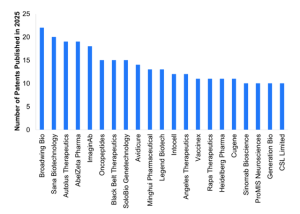
Graph showing Bispecific patent publications by select developers in 2025.
The data highlights a group of organizations that are rapidly increasing their activity in the field. With the exception of Broadwing Bio, all of the companies featured already appear on Beacon as developers in other modalities, underlining a broader strategic shift as firms extend their existing expertise into bispecific and multispecific platforms. This diversification provides a useful early signal of where competition may intensify and which partners or acquisition targets may become more attractive over time.
Beacon Bispecific Patents allows users to go beyond the headline chart and examine the underlying filings for each company, track changes in assignee, and follow how their patent families evolve. This supports more structured competitor monitoring, whether teams are assessing who is crowding a particular target class or mapping the engineering approaches that rivals are favouring.
Designed for competitor, IP and R&D teams
Beacon Bispecific Patents combines patent specialists with AI to cut down noise before results reach the user. Filings from over 100 patent offices are evaluated and summarised in clear technical language, with key claims and molecular features highlighted so that scientists can rapidly assess relevance.
Using the platform, teams can:
- Benchmark competitor portfolios by target, format, mechanism or disease area
- Identify potential infringement or overlap risks earlier in development
- Track how competitors enter new indications or move between technologies
- Spot white space where there is limited or no patent activity
- Export curated sets of patents for more detailed internal review
This level of structure means competitor intelligence teams are not starting from a blank page each time they assess a question. Instead, they can move straight to analysing patterns in filing behaviour and how those patterns align to broader portfolio strategy.
Andy Cook, Chief Data Innovation Officer, added: “Our customers are asking not just ‘what patents exist’, but ‘what does this tell us about our competitors and our own room to manoeuvre’. Beacon Bispecific Patents has been designed with that in mind. It gives a much clearer sense of where others are betting in the bispecific space and how secure those positions may be.”
Part of a broader patent intelligence platform
The bispecific dataset sits alongside Beacon’s ADC patent data , all accessible through a single interface. Together, they provide a joined-up view of patent activity across key therapeutic technologies, supported by the same ontologies, filters and summary approach that underpin Beacon’s drug, trial, company and deal datasets.
By bringing these sources together, Beacon aims to help users connect scientific innovation, IP strategy and commercial planning in a more coherent way. Patent activity can be viewed in context with clinical pipelines, company portfolios and partnering activity, offering a richer picture of how competitors are positioning themselves and where future opportunities may lie.
Find out more or request a demonstration for Beacon Bispecific Patents today!